
The Three Levels of Consciousness

The human mind can be divided into three levels of consciousness. These are: The Conscious: This is the level of awareness. It includes whatever you are aware of at the current moment and the mental processes and thoughts that are going on alongside that. For example, whatever you are seeing, thinking about, and the feeling of sitting on a chair are all examples of the conscious mind. The Subconscious/Preconscious: This is the level of accessible memory. It contains all of that information which can be recalled and remembered at will. For example, if you need to remember a specific path, you can recall it as soon as you need. The Unconscious: This consists of our instinctive wishes as Read more [...]
Silent Vibrations

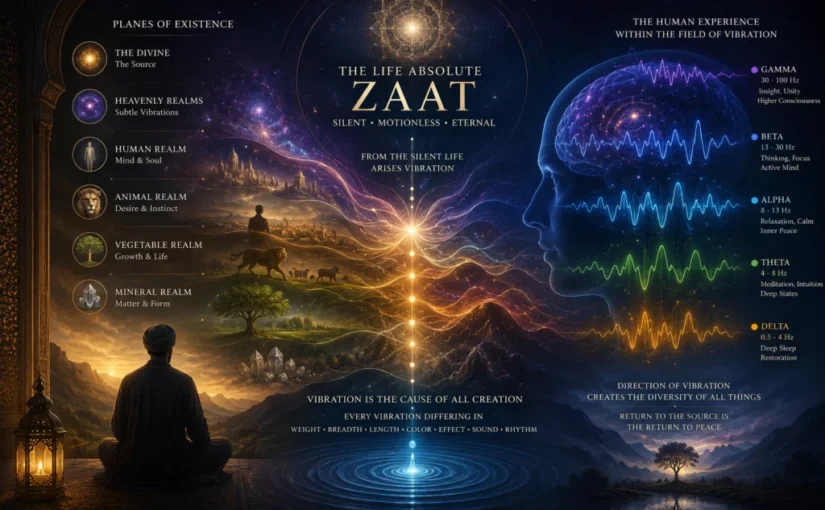
The Life Absolute from which has sprung all that is felt, seen, and perceived, and into which all again merges in time, is a silent, motionless and eternal life which among the Sufis is called Zaat. Every motion that springs forth from this silent life is a vibration and a creator of vibrations. Within one vibration are created many vibrations; as motion causes motion so the silent life becomes active in a certain part, and creates every moment more and more activity, losing thereby the peace of the original silent life. It is the grade of activity of these vibrations that accounts for the various planes of existence. These planes are imagined to differ from one another, but in reality they cannot Read more [...]

Understanding of Muraqabah

Muraqaba is a sufi term that means fear, to inspect, to watch over, to take care of, to control, to look at one’s inner world, to be entranced, to think of the aim at all times, to look at Allah with the heart at all times, to keep the soul under control in order to protect the heart from bad deeds, to know that Lord knows every state of a person, to dismiss everything from one’s mind and be ready to receive inspiration from Allah by kneeling down and closing the eyes. The gist of the teachings of the prophets of Allah is that man after negating the fictional sight, should equip himself with that sight which witnesses the reality. Entering into one after leaving the other or getting something Read more [...]

Khwaja Mu‘in al-Din Hasan Chishti Ajmeri رحمۃ اللہ علیہ

His personal name was Hasan, while his titles included Mu‘in al-Din, Mu‘in al-Awliya, Khalifat al-Rasul fi al-Hind, Hind al-Wali, Shahanshah-e-Mashaikh, Sultan al-‘Arifin, Burhan al-‘Ashiqin, Shaykh al-Islam, Gharib Nawaz, Sultan al-Hind, Na’ib Rasul fi al-Hind, and Sadr-e-Bazm-e-Chishtiyan. He was both حسنی and حسینی, and his noble lineage reaches Amir al-Mu’minin حضرت علی المرتضیؓ in the thirteenth generation. He was born in the region of Sijistan in 537 AH / 1139 CE. For this reason, some biographers referred to him as “Sijzi,” and he became widely known as Hasan Sijzi. For the first eleven years of his life, he was raised in great comfort and prosperity. Read more [...]

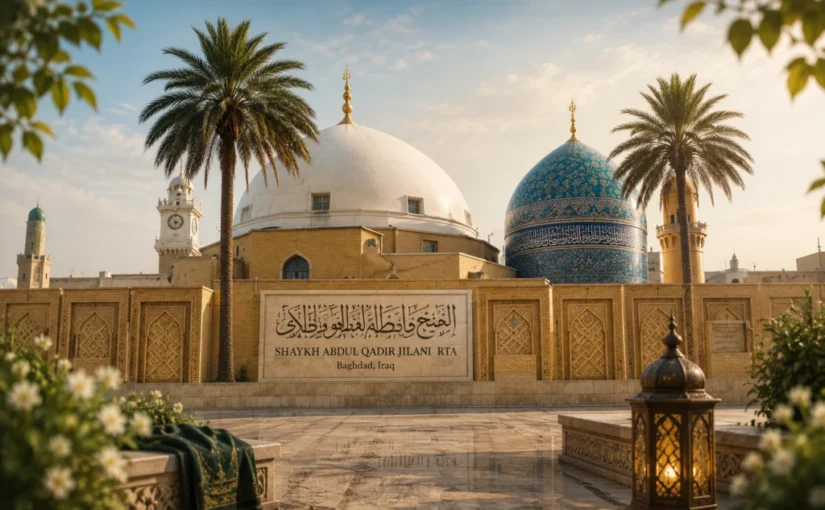
Shaykh Abdul Qadir Jilani رحمۃ اللہ علیہ

Life and Teachings Shaykh Abdul Qadir Jilani علیہ الرحمہ was a great عالمِ باعمل and a devoted follower of Shariyah, as well as a distinguished ولی اللہ. His spiritual rank and ولایت become evident through his own books and teachings. His full name was عبدالقادر بن ابو صالح عبداللہ بن جنکی دومت الجیلی (الجیلانی). His kunyah was ابو محمد, while his titles included محی الدین and شیخ الاسلام. He followed the Hanbali madhhab and his عقائد were those of اہل السنۃ والجماعۃ. He himself stated: “Our عقیدہ is the same as that of all صحابۂ کرام and سلفِ Read more [...]
error: Content is protected !!